
Teacher shortage: Continuing with the „Klasse Job" strategy and ensuring teaching quality
As early as 2009, the Federal Ministry of Education predicted a teacher shortage from the 2018/19 school year onwards, unless appropriate countermeasures were implemented. However, comprehensive and systematic measures were not undertaken. Additionally, the 2013 reform extended the duration of teacher education, resulting in a one-year gap in new graduations. It was not until autumn 2022 that the Federal Ministry of Education launched a comprehensive initiative to counteract the shortage with its „Klasse Job" strategy. (The name of the strategy is a wordplay, as Klasse means both „(school)class" and „awesome" in German.) The actual shortage of teaching staff was mainly compensated for by the existing staff taking up additional teaching duties, teaching outside one’s specialized field and by the employment of teaching staff with partial qualifications. In the report „Teaching staff Deployment" ( „Lehrpersonaleinsatz (pdf)“ published today and covering the school years from 2018/19 to 2023/24, the Federal Ministry of Education, the provinces of Upper Austria and Tyrol, and the respective education authorities were audited.
Klasse Job: Strong interest in career changes
As one of eight sub-projects of the Klasse Job departmental strategy, the possibility for a lateral career move to teaching positions in academic secondary schools (AHS) was extended to graduates in related fields. The Ministry originally expected 300 applications per school year to be reviewed by the certification commission with respect to the applicants’ pedagogical, professional and personal suitability. After the implementation in the 2023/24 school year, a total of 5,012 people applied, of whom around half received the certification. However, of these 2,426 certified individuals, only 696 taught in the 2023/24 school year. Between 2022 and 2023, a total of EUR 604,300 was paid out for the Klasse Job career change programme.
The Austrian Court of Audit recommends ensuring that certified individuals apply for positions more frequently and remain in teaching positions in the long term. It also calls for a cost-efficient implementation of the model. Furthermore, the ACA criticised the fact that the legal quality and binding nature of the certificates had not been definitively clarified. Overall, the Austrian Court of Audit recommends continuing with the Klasse Job strategy when defining and implementing measures to meet teaching staff requirements in a timely and targeted manner in the future, while ensuring the quality of teaching.
Forecast model did not reflect the shortage adequately
There was a need for improvement in the model forecasting the demand for teaching staff. The Federal Ministry of Education was only able to calculate forecasts for the distribution of teaching subjects in the federal school system. An accurate, high-quality forecast of the expected teacher shortage in compulsory education for individual subjects, as well as for specific schools and school types, was missing, and neither was a forecast of the number of teacher education graduates offered.
Compensating for teacher shortages
The ACA is critical of the discrepancy between the numbers of announced positions and graduates: In the 2023/24 school year, the Federal Ministry of Education advertised a total of 6,846 positions, meanwhile in the 2022/23 school year, the number of graduates of all teacher education programmes with bachelor’s and master’s degrees was 5,602.
In 2013, teacher education underwent reform; the „New Educator’s training” („PädagogInnenbildung NEU“) also extended the duration of studies and may thus have contributed to the increase of teacher shortage. The change in teacher education in 2024 shortened the duration of the bachelor’s degree programme for teachers again.
In Austria, at the beginning of the 2023/24 school year, 267 advertised teaching positions received no applications. The provinces of Salzburg, Upper Austria and Tyrol were the most affected – particularly in primary (Volksschulen) and secondary schools (Mittelschulen).
In relation to the total number of teachers in Austria – 126,993 in the 2023/24 school year – the number of vacancies was low. This is partly due to the fact that the actual shortage of teaching staff was mainly compensated for by the existing staff taking up additional teaching duties, teaching outside one’s specialized field and by the employment of teaching staff with partial qualifications. The ACA criticises the unsustainability of this approach.
Additional teaching duties amounting to work of around 7,000 full-time employees
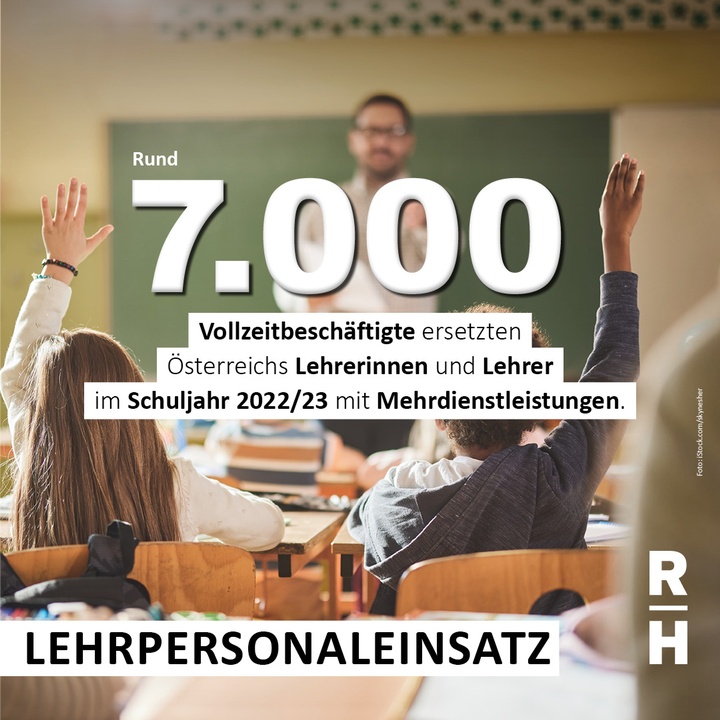
In the 2022/23 school year, Austria’s teachers replaced around 7,000 full-time teachers through additional duties. Additional work was primarily carried out by federal teachers. The ACA identifies a risk of increased workload for individual teachers. Additionally, the considerable accumulation of time credits could defer the shortage of teaching staff and thus ultimately worsen it again. Therefore, new teacher hires should not be viewed as a last resort to meet the demand for teachers.
High proportion of female teachers working part-time
The proportion of teachers working part-time has risen, particularly since the 2020/21 school year: In the 2023/24 school year, 39.5% of teachers in Austria were employed part-time, and the part-time rate for women (43% for federal teachers, 38% for teachers employed by one of the 9 federal provinces) was significantly higher than for men (26% for federal teachers, 22% for provincial teachers). The ACA sees potential for reducing the teacher shortage by lowering the high part-time employment rate. Binding strategies to reduce part-time employment rates are imperative.
Teaching staff with special contracts, especially in primary and secondary schools
Students who have completed less that 120 ECTS in their teacher education degree or individuals with no teacher training whatsoever were given a special contract. In Upper Austria, teacher education students with special contracts had an average of 68 ECTS credits in the 2023/24 school year, and among those employed were three people with 0 ECTS credits, meaning that they were at the beginning of their teacher education.
Nine per cent of all teachers had a special contract in the 2023/24 school year. The ACA is particularly critical of the 64% nationwide increase in the number of province teachers with special contracts and of the 86% increase in Upper Austria during the audit period.
Teachers on special contracts were mainly employed in primary and secondary schools. In this context, the ACA emphasised the importance of ensuring high-quality teaching. It recommends reducing the number of teachers on special contracts and restricting the deployment of first-year students.
Reducing teaching outside one’s specialized field
Teachers should, in principle, teach the subjects for which they are fully qualified. While, according to the Federal Ministry of Education, there was hardly any teaching outside the teacher’s specialized subject area at federal schools, in the 2023/24 school year, a total of 35% of subjects at secondary schools in Upper Austria and 46% in Tyrol were taught by a teacher with a different specialization.
Certain subjects were taught almost entirely by teachers without subject-specific qualifications – for example,computer science in Tyrol 90% of the time and basic digital education in Upper Austria 81% of the time. In both provinces, even the so-called core subjects were taught by teachers without subject-specific training, for example German – 22% in Upper Austria and 19% in Tyrol. Mathematics was taught by teachers without subject-specific training in both federal provinces 16% of the time. In this context, the ACA once again stresses the need to ensure the quality of teaching. The high proportion of provincial teachers teaching subjects outside their specialized fields should be reduced.
- pdf Datei:
- 5,410.4 KB
- Umfang:
- 132 Seiten