
Just Transition Fund: insufficient data for the allocation of funds
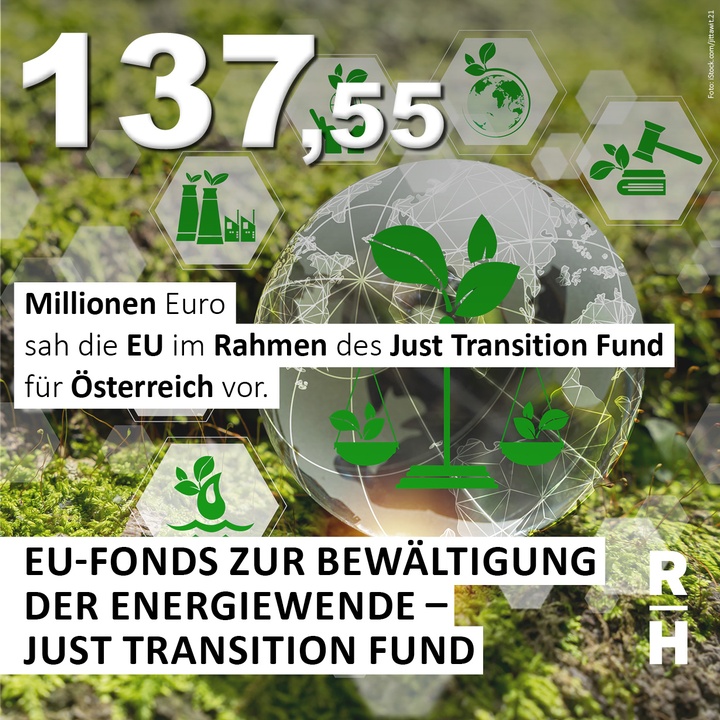
The Just Transition Fund (JTF) is a financial instrument established by the EU in 2021 as part of the European Green Deal. It was designed to support regions facing serious socio-economic challenges as a result of the EU’s transition to a climate-neutral economy. In national territorial plans, the EU Member States were required to identify the regions particularly affected by this transition. In Austria, however, the data available for identifying these areas was insufficient, as the Austrian Court of Audit (ACA) notes in its report "EU Fund for Addressing the Challenges of Energy Transition – Just Transition Fund" (pdf, in German) published today. In this context, the ACA recommends that, for future region-specific funding, the available funds be allocated as closely as possible in line with actual needs, based on robust data that provides clear evidence for the allocation. The audited period essentially spanned the years from 2020 through 2024.
JTP regions and funding in Austria
In its Just Transition Plan (JTP), Austria designated regions in the provinces of Carinthia, Lower Austria, Styria and Upper Austria: Unterkärnten, Mostviertel-Eisenwurzen, Niederösterreich-Süd, Traunviertel, Östliche Obersteiermark and Westliche Obersteiermark. In addition, individual districts from other regions were included, such as Feldkirchen, Wels-Stadt, Graz-Umgebung and Deutschlandsberg.
A total of around EUR 201 million in public funding was available to Austria for the implementation of projects under the JTF: EUR 135.77 million in EU funding for the JTF (at 2021 prices) and EUR 64.84 million in national public co-financing. Eligible projects could include, for example, the establishment of research or demonstration facilities for decarbonization technologies or green hydrogen.
Regulation on the identification of regions lacked specificity
The JTF Regulation did not specify how the areas eligible for funding were to be identified. However, the European Commission considered it essential that JTF funding be concentrated as much as possible within a contiguous geographical area. According to the Commission, economically strong regions such as Wiener Umland/Südteil or Linz-Wels should not be included.
Energy Mosaic as the primary data source
In the absence of sufficient information, the cross-programme working group tasked with developing Austria's JTP defined key parameters for a data-based approach to identifying the relevant areas. For this purpose, it used the so-called Energy Mosaic as its primary data source. The Energy Mosaic contained data on energy consumption and the associated greenhouse gas emissions of all Austrian cities and municipalities. However, it did not include process-related greenhouse gas emissions from industrial transformation processes, such as those occurring in blast furnaces. As a result, emissions from individual industries could be significantly underestimated. Moreover, the data contained in the Energy Mosaic dated from 2011.
A February 2022 study (Austrian Institute of Economic Research, Transformation and “Just Transition” in Austria) found significant discrepancies between the regions most affected by the transition to a climate-neutral economy and the areas covered by the JTP. Two of the districts identified by the study as being among the most affected – Reutte and Braunau – were not included in the JTP.
Although the study only became available towards the end of the JTP's development, the ACA nevertheless criticized the JTP working group for not examining the differences in the geographical delineation. The ACA recommends that the Austrian Conference on Spatial Planning take comprehensive account of study findings when preparing plans or programmes to ensure that they are up to date and accurately targeted.
Needs-based allocation of funds
In accordance with a decision by the Conference of Provincial Governors, the provinces were responsible for the allocation of EU funds. However, the considerations and basis underlying this allocation could not be substantiated. Moreover, no reasons or evidence-based data could be provided to the ACA to explain why provinces in which no JTP regions had been designated received a solidarity contribution. These provinces were allocated an additional EUR 12.20 million in EU funding from two other EU funds on a pro rata basis.
The basis for allocating JTF funding among the provinces with JTP regions was likewise not transparent: around EUR 24 million each for Carinthia and Lower Austria and around EUR 42 million each for Upper Austria and Styria. The ACA criticizes the fact that the allocation was not data-based and points to the risk that the funds may not have been allocated according to actual needs.
The ACA therefore recommends that the Federal Ministry of Agriculture, the Federal Ministry of Labour and the Province of Upper Austria (which was specifically audited) ensure that, in future, funding for region-specific support is allocated as closely as possible in line with actual needs, based on robust data that clearly supports the allocation.
By the end of 2024, a total of EUR 1.19 million (0.9%) of the JTF funding available to Austria had been disbursed.
- pdf Datei:
- 4,681.6 KB
- Umfang:
- 106 Seiten
Report: EU Fund for Adressing the Changes of Energy Transition – Just Transition Fund (in German)
From October 2024 to May 2025, the Austrian Court of Audit (ACA) carried out an audit of the implementation of the Just Transition Fund at the Federal Ministry of Agriculture, the Federal Ministry of Labour, the Austrian Conference on Spatial Planning and the Province of Upper Austria. The audit focused in particular on assessing the basis for and processes underlying decisions on the Just Transition Plan, the delineation of measures financed by the Just Transition Fund from the other priorities and measures under the European Regional Development Fund and the European Social Fund Plus, the selection of projects for funding, the administration of funding and monitoring. The audited period essentially spanned the years from 2020 through 2024.