
Swiftly putting a single European rail system on track
The European Rail Traffic Management System (ERTMS) was introduced to enable trains to run across national borders throughout the EU rail network without technical and administrative barriers. The legal framework set by the European Commission for this purpose is binding on the Member States. Central to this is the European Train Control System (ETCS), to which national railways must upgrade, covering not only the railway lines but also the trains and locomotives. For the ÖBB Group, the implementation of ERTMS brought about a significant digitalization boost, as the Austrian Court of Audit (ACA) notes in its report „European Rail Traffic Management System in the ÖBB Group“ (pdf, in German), which was published today. At the time of the ACA's audit, the Austrian Federal Railways (ÖBB) were using both established national train control systems and ETCS. In some cases, however, the ÖBB were unable to put already converted systems into operation because approvals from the Federal Ministry of Innovation, Mobility and Infrastructure were pending. The ACA recommends completing outstanding procedures as soon as possible. The audited period essentially spanned the years from 2020 through 2024.
Upgrading trains and routes along the trans-European corridors
TEN-T core networks are the trans-European rail corridors. They are of central importance for European passenger and freight transport. By 2050, only ERTMS should be in use across the entire European rail network. Four TEN-T corridors run through Austria. As of end-2024, approximately 44 per cent of Austria’s TEN-T core network was equipped with ERTMS. The proportion of the ÖBB network covered by ERTMS stood at 12 percent.
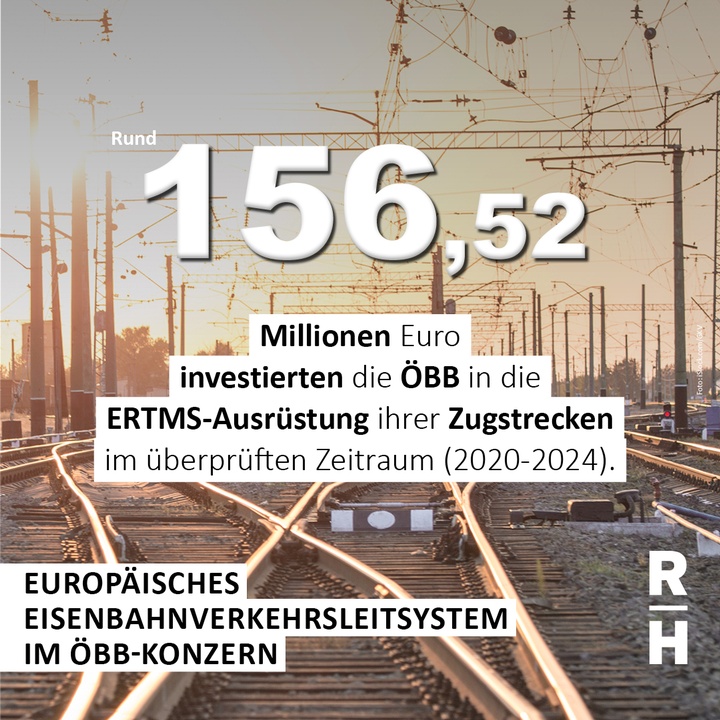
ÖBB-Infrastruktur AG invested around EUR 156.52 million in ERTMS equipment for its railway lines between 2020 and 2024. Investments totalling EUR 646.70 million are planned for the 2025–2030 planning period. The attributable investments in rolling stock – multiple units, locomotives and maintenance vehicles – amounted to EUR 287.83 million by the end of 2024. These were to be borne by the fleet operators within the ÖBB Group.
Increasing safety and line capacity
ERTMS promises to improve both safety – by making it easier to prevent collisions – and line capacity. ERTMS has only a limited impact on train punctuality.
At the heart of ERTMS lies the European Train Control System (ETCS). What makes it special is that ETCS monitors a train's position and speed and checks whether authorization to proceed is available for the next section of track to be travelled. Data communication between trains and the rail infrastructure currently takes place via the Global System for Mobile Communications-Railway (GSM-R) mobile communications system, which must be replaced by its successor, the Future Railway Mobile Communication System (FRMCS), by 2035. Automatic Train Operation (ATO) is also part of ERTMS, but is still in the early stages of development.
More than 20 national systems
At the time of the ACA's audit, more than 20 different national train control systems were still in use across Europe alongside ERTMS. The ÖBB-Infrastruktur AG network was still fragmented. While the mixed operation of ETCS alongside established national train control systems allows trains without ERTMS to be used, the full operational and financial advantages of operating solely with ETCS cannot yet be harnessed.
Removing legal uncertainties
At the time of the ACA's audit, regulatory approvals from the Federal Ministry of Innovation, Mobility and Infrastructure were still pending for five ERTMS subsystems, even though the installations had already been technically completed. The reason for this was legal uncertainty regarding authorization requirements under railway legislation. As a result, the installations could not be put into operation. In view of the expected improvement in safety that ERTMS will bring compared with the existing equipment, the ACA recommends that outstanding legal issues be clarified and pending procedures concluded as soon as possible.
Upgrading the Vienna S-Bahn core line
The ETCS system is also set to be implemented, for example, on the 13-kilometre-long main S-Bahn (suburban train network) line in Vienna. It is one of the busiest lines in Austria and runs between Vienna Meidling and Vienna Floridsdorf stations. It is due to be refurbished and modernized in the coming years. ETCS is a prerequisite for increasing line capacity by reducing the minimum headway between trains from around three minutes to 2.5 minutes. These very short headways require the latest version of ETCS, as well as a high level of availability and reliability of the rolling stock. Consequently, the ACA urges the development of contingency plans that include effective strategies for restoring scheduled services in the event of a disruption.
Systems must be compatible
Another point highlighted by the auditors is that, as ERTMS is constantly being developed, fleet operators within the ÖBB Group have in some cases had to retrofit rolling stock that was already equipped with ERTMS to ensure it is compatible with the trackside equipment. There is also a need for optimisation in cross-border rail transport: if ERTMS components are incompatible due to differing system versions, this impedes the seamless operation of longer sections of track. Mandatory compatibility tests between the track and rolling stock, as well as the necessary acquisition of digital keys (ETCS keys) in cross-border rail transport, have undermined the vision of pan-European interoperable rail transport.
- pdf Datei:
- 4,947.2 KB
- Umfang:
- 98 Seiten
Report: European Rail Traffic Management System in the ÖBB Group (in German)
Between March and September 2025, the Austrian Court of Audit (ACA) carried out an audit of the financial management of the Federal Ministry for Innovation, Mobility and Infrastructure, the Österreichische Bundesbahnen-Holding Aktiengesellschaft, the ÖBB-Infrastruktur Aktiengesellschaft, the ÖBB-Personenverkehr Aktiengesellschaft and the ÖBB-Produktion Gesellschaft mbH with regard to the implementation of the European Rail Traffic Management System (ERTMS). The main aim of the audit was to assess the implementation of ERTMS on the track and in rolling stock within the ÖBB Group, compliance with European and national requirements, and the state of coordination with neighbouring railways. Further audit objectives included analysing the costs incurred to date and those expected in future for the implementation of ERTMS within the ÖBB Group, as well as assessing the contribution of ERTMS to improving safety, punctuality and line capacity. The ACA also analysed the operational and economic impacts of the implementation timetable. The period covered by the audit essentially spanned the years from 2020 through 2024.