
Many climate tickets sold, but environmental impact remains limited
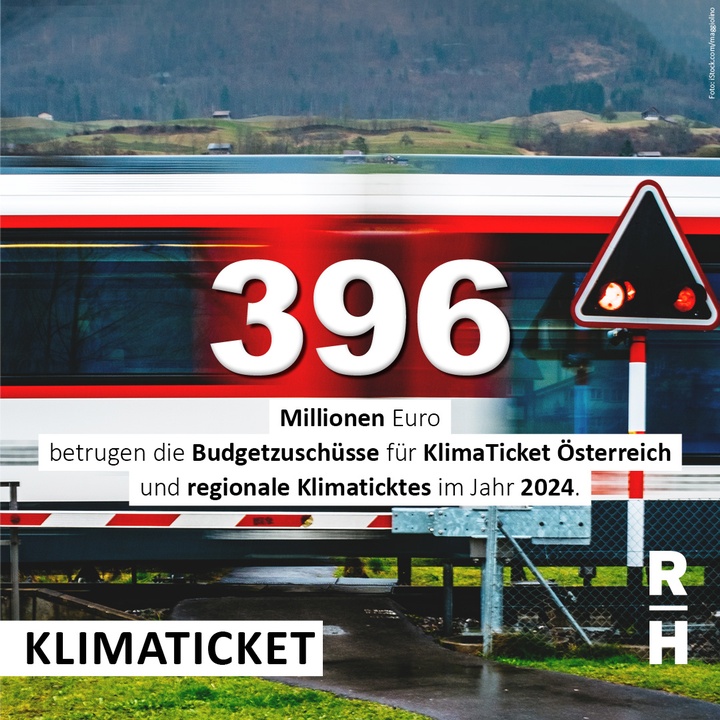
As of 26 October 2021, the "KlimaTicket Österreich" (a flat-rate annual ticket) has been valid for almost all public transport services across Austria. Gradually, regional climate tickets were also introduced in all provinces. The Federal Ministry of Transport and the transport associations introduced these tickets as part of three transport policy measures designed to render public transport more appealing: a single ticket for all public transport services, additional funding for new transport offerings and reduced prices for annual passes. Budgetary subsidies for these measures amounted to EUR 396 million in 2024. In 2023, twice as many KlimaTickets Österreich were sold as forecast. The ministry did not have information on which customer groups were driving this high demand. To comprehensively assess the macroeconomic impacts, such data are needed, as noted by the Austrian Court of Audit (ACA) in its report „KlimaTicket“ published today. Data should also be collected on the travel behaviour of specific age groups – particularly before introducing subsidies for tickets targeted at those groups. The audited period essentially covered the years from 2019 through 2023.
Twice as many tickets sold as forecast
In November 2020, the Federal Ministry of Transport commissioned an external consulting firm to produce a forecast addressing the following questions: How many KlimaTickets Österreich are expected to be sold at the specified rate, and what loss of revenue can be anticipated for the transport associations and transport operators as a result?
In 2023, approximately twice as many KlimaTickets Österreich were sold (243,754) as had been forecast (124,000).
In this context, the ACA criticizes the fact that only the external consulting firm had access to the underlying data and the exact modelling of the demand forecast. The highly aggregated results of the forecast were not fully transparent, even though these figures formed the basis for substantial financial flows.
From October 2021 to end-2024, budgetary subsidies totalling EUR 520 million were required for the KlimaTicket Österreich. Subsidies for regional climate tickets amounted to a further EUR 610 million over the same period.
Given this level of expenditure, the macroeconomic implications of the KlimaTicket Österreich should be assessed.
Macroeconomic implications of the KlimaTicket
Lower air pollutant emissions and vehicle operating costs, fewer accidents involving personal injury, reduced noise pollution, and less traffic congestion – the list of potential macroeconomic implications resulting from a change in mode of transport is diverse. However, the Federal Ministry of Transport assessed only the impact of reduced greenhouse gas emissions.
It assumed a reduction of 0.11 million tonnes of CO₂ equivalents in 2024 solely from shifting car trips to rail passenger transport. Total greenhouse gas emissions in the transport sector amounted to around 20 million tonnes of CO₂ equivalents in 2023; the KlimaTicket was expected to reduce these by 0.2 per cent.
In view of the transport sector’s overall emissions, the ACA considers this expected reduction to be rather limited. The ministry had not defined a comparable target for shifting car trips to bus transport.
Subsidies for age-specific groups
In 2024, the Federal Ministry of Transport introduced the free KlimaTicket Österreich for 18-year-olds. There was no transparent assessment weighing the financial resources required for this free scheme against alternative uses of those funds for infrastructure development or the expansion of public transport services. Nor was the ministry aware of how many young adults had already been regular users of public transport prior to the scheme.
Furthermore, there were no analyses of longer-term public transport usage following the uptake of the free KlimaTickets, nor any objectives based on such findings. Moreover, the Ministry did not investigate whether, and to what extent, a tiered pricing transition from low-cost youth tickets to the ‘KlimaTicket Österreich Jugend’ could encourage young adults to become regular users of public transport.
Young adults were the primary users of the KlimaTicket Österreich
Market penetration of the KlimaTicket Österreich was by far highest among young adults aged 18 to 25. Consequently, the ACA found the Federal Ministry of Transport’s assumption that young adults constituted an underrepresented customer group to be unsubstantiated.
In its assessment of the impact of the free ‘KlimaTicket Österreich’ for 18-year-olds, the ministry had relied on unrealistic assumptions about their travel behaviour. For example, it assumed that, in absence of the free ticket, all users would have travelled by car.
The factors influencing public transport usage had not been examined. Nor did the ministry address the question of whether the ticket price is the decisive factor in increasing public transport use, or whether other factors – such as insufficient service provision in rural areas – play a more significant role.
The free KlimaTicket Österreich for 18-year-olds was discontinued on 19 April 2025.
The appeal of public transport matters most
For 2025, the Federal Ministry of Transport planned a comprehensive evaluation of the KlimaTicket Österreich and its associated objectives.
The ACA recommends to distinguish between changes in travel behaviour resulting from factors beyond policy influence – such as population growth – and those attributable to the reduced annual pass fare. According to the evaluation of the Vienna model, the most effective way to increase demand for public transport is to make it more appealing whilst at the same time making private motorized transport less appealing.
- pdf Datei:
- 3,516.6 KB
- Umfang:
- 96 Seiten
Report: KlimaTicket (in German)
From June to October 2024, the Austrian Court of Audit (ACA) carried out an audit of the financial management of the Federal Ministry of Climate Action, Environment, Energy, Mobility, Innovation and Technology, the provinces of Salzburg and Upper Austria, the OÖ Verkehrsverbund-Organisations GmbH Nfg. & Co KG and the Salzburger Verkehrsverbund Gesellschaft m.b.H. It assessed the legality, economy, efficiency and effectiveness of the performance of tasks related to the transport policy measures implemented upon the introduction of the KlimaTicket Österreich and the regional climate tickets. The period covered by the audit essentially spanned the years from 2019 through 2023.
In light of the amendment to the Federal Ministries Act, which entered into force on 1 April 2025, the ACA addresses its recommendations to the newly responsible Federal Ministry of Innovation, Mobility and Infrastructure.