
Transparency of costs is required for the energy transition
Austria has set itself the goal of increasing the share of renewable energy. However, only a rough estimate of how much the energy transition will cost was available, and its underpinnings were not transparent. In the report „The land used for electricity generation from renewable energy sources“ („Flächen für Strom aus erneuerbaren Energieträgern (pdf)“) published today, the auditors of the Austrian Court of Audit therefore call for calculations that are as transparent as possible. With the expansion of renewable energy, the need for additional transmission lines and land, for example for photovoltaic systems, is also increasing. The ACA recommends that appropriate precautions be taken, for example in the area of land use planning. The land required for power lines must be secured and kept available from an early stage. The audit was carried out at the Ministry of Climate Action and in the provinces of Lower Austria and Upper Austria, primarily covering the years 2018 to 2022. The National Energy and Climate Plan (NECP) 2024, which was adopted on 17 December 2024, was therefore not covered by this audit.
Transparent calculations
In Austria, electricity consumption (nationally, according to the balance sheets) is to be covered 100 percent by renewable energy sources from 2030 onwards. This is regulated by the Renewable Energy Expansion Act. In addition, according to the NECP 2019, the share of renewable energy in gross final energy consumption – that is, in all types of energy, such as electricity, district heating, fuels and combustibles for heat generation – should be increased to between 46 and 50 percent by 2030.
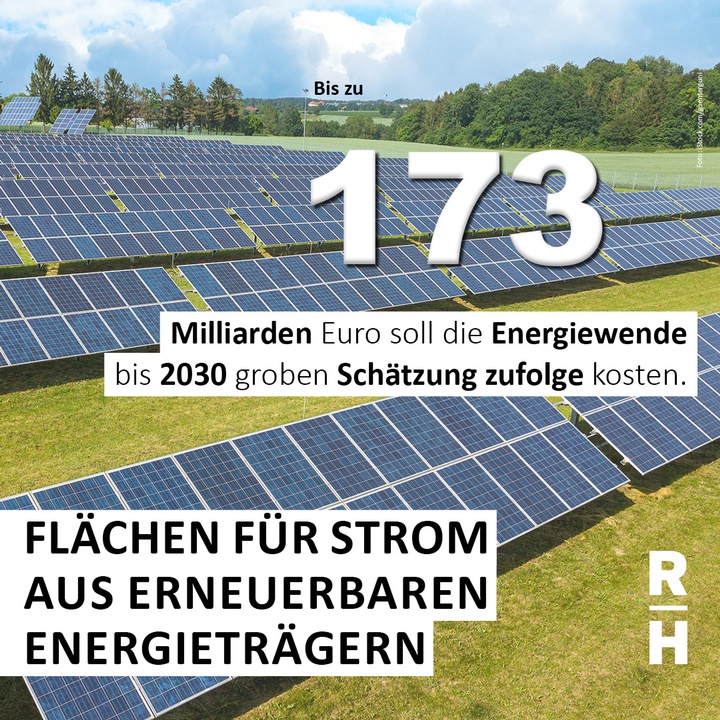
The ACA critically notes that, prior to the adoption of the Renewable Energy Expansion Act, there was no consultation with the provinces on the distribution of their contributions to the expansion targets. Furthermore, no detailed information on the costs of the energy transition was available, instead only a rough estimate was provided, the underpinnings of which were not transparent. The total investment volume up to 2030 was estimated at between EUR 166 billion and EUR 173 billion. Of this, EUR 20 billion to EUR 27 billion was to be spent on expanding electricity generation from renewable energy sources and EUR 6 billion on expanding the electricity grids. It was also unclear how the necessary funds would be divided between the public and private sectors.
The recommendation of ACA is that the Ministry of Climate Action should substantiate and document the estimates of the costs of the energy transition with calculations that are as transparent as possible.
According to NECP 2024, the aim is to further increase the share of renewable energy to at least 57 percent.
Contributions from EU Member States: the ACA criticises lack of transparency
EU Member States are obliged to contribute to the EU’s target of supplying a certain proportion of gross final energy consumption from renewable sources. They set their respective contributions in their NECPs. In the Renewable Energy Directive RED III issued on 31 October 2023, the EU’s overall target for 2030 was increased from 32 percent to at least 42.5 percent by 2030. A further increase to 45 percent is aimed for.
An overview of the amount contributed by each Member State was not available on either the European Commission’s website or the website of the Ministry of Climate Action. This meant that there was a lack of transparent information on the respective national share of the EU’s overall target for renewable energy.
Provinces and municipalities should be involved at an early stage in the future
In view of the challenges for the energy infrastructure posed by the expansion of renewable energy sources, the ACA considers the development of the Integrated Network Infrastructure plan (NIP) to be a matter of urgency. The NIP focuses in particular on the electricity transmission network and the gas transmission network. The Minister for Climate Action published the NIP on 8 April 2024 – around nine months late. In this context, the ACA criticises, among other things, that after the Renewable Energy Expansion Act came into force in July 2021, the Ministry of Climate Action only involved the provinces in the consultations on the NIP from November 2022 onwards and did not consult the municipalities at all. The ACA recommends that the provinces, the Austrian Association of Cities and Towns and the Austrian Association of Municipalities be involved at an early stage in future updates to the NIP.
Securing land at an early stage
Unlike other countries, the federal government in Austria has no “framework competence” (i.e. legislative authority to issue general framework laws) in the area of land use planning. Only through its sectoral competence did the federal government have the possibility to take action in the area of spatial planning at the national level. The provincial government of Lower Austria enacted legally binding spatial planning instruments to allocate and reserve land for photovoltaic systems and wind power. In Upper Austria, only non-binding management instruments were available for this purpose.
Due to the expansion of renewable energy sources, there is a high demand for additional transmission lines and thus for land that is required for them and which must be reserved. The land required for power lines must therefore be secured and kept available at an early stage in order to be able to implement the expansion targets for electricity generation from photovoltaics, hydropower and wind power set at federal and provincial level.
The ACA notes that the province of Lower Austria did not issue any land use planning programmes to ensure that routes for future power grids remain available. In Upper Austria, a land use planning programme for the construction of the 220 kV supply line for central Upper Austria had been available since September 2022.
The ACA recommends that the provinces of Lower Austria and Upper Austria issue land use planning programmes to secure routes for high-priority power lines and for the related planning.
It is unclear how much land is needed to achieve the energy targets
Neither the Ministry of Climate Action nor the province of Upper Austria had data on the land use that would be necessary to achieve the energy targets. The province of Lower Austria examined the space required for photovoltaic systems to achieve its energy targets in accordance with the Lower Austrian Climate and Energy Roadmap 2020 to 2030, as well as the space required for wind turbines.
In order to achieve the 2030 targets for electricity generation from photovoltaic systems, large open spaces are required even after taking into account the possible areas on top of buildings: between 51 and 184 square kilometres across all of Austria, up to 17 square kilometres in Lower Austria and up to 25 square kilometres in Upper Austria. In order to achieve the provinces’ targets, in Lower Austria, the electricity generation from photovoltaics would have to approximately triple by 2030 in comparison to 2022, while in Upper Austria it would have to roughly quadruple.
The ACA critically notes that the Ministry of Climate Action was unable to monitor the legally prescribed target of equipping one million roofs with photovoltaic systems due to a lack of data. Furthermore, no conclusions about the amount of generated energy could be drawn from the number of roofs with photovoltaic systems. According to the 2020–2024 government programme, land owned directly or indirectly by the state should be used for renewable energy. However, the Ministry of Climate Action did not have an overview of renewable energy installations on federal buildings or state-owned land.
Outlook: climate neutrality by 2040
The study „Energy and greenhouse gas - Transition 2040 scenario“ („Energie- und Treibhausgas-Szenario Transition 2040“) commissioned by the Ministry of Climate Action analysed whether and how the goal of climate neutrality could be achieved by 2040. If this scenario is pursued, it would be necessary to expand electricity generation from renewable energy sources beyond the previous energy targets. The ACA recommends paying attention to the economic and social impacts, such as the consequences of inflation, in light of the average inflation rate from 2031 to 2040 in the „Energy and greenhouse gas - Transition 2040 scenario“ being around one third higher than the inflation rate of two percent targeted by the European Central Bank in the medium term.
- pdf Datei:
- 3,856.2 KB
- Umfang:
- 110 Seiten